
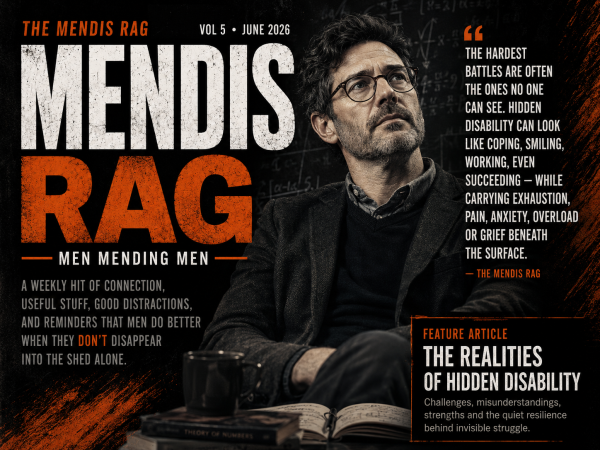
The Mendis Rag · Vol 5 · June 2026
Invisible Battles.
Visible Humanity.
This issue is about hidden disability, the armour men build around pain, the lazy public stories that flatten autistic people into budget lines, and the very real problem of trying to live independently in a world that still forgets to send the bloody taxi.
Feature Article
The Armour Of Hidden Disability
There is a strange cruelty in looking well when you are not.
Obvious physical disability can bring its own brutal catalogue of barriers: stairs, doors, toilets, transport, staring, pity, awkward strangers, and the lifelong administrative hobby of asking public places to please consider the existence of human bodies. Nobody sensible should turn that into a competition. Disability is not the Paralympics of suffering. There are no medals for “most inconvenient nervous system.”
But hidden disability has a different kind of ache. It asks a person to carry the weight and the explanation. The pain is real, but the proof is invisible. The fatigue is real, but the face looks fine. The sensory overload is real, but the room says “everyone else is coping.” The brain fog is real, but the email still needs a reply by 5pm.
That doubt gets under the skin. It changes how a man walks into a room. He learns to ration honesty. He learns which symptoms are socially acceptable and which ones make people look at their shoes. He learns to say “just tired” when he means “my body feels like a faulty extension cord and my brain has opened forty-seven tabs, twelve of which are playing music.”
Over time, the armour becomes identity. The joker. The worker. The reliable one. The bloke who does not complain. The high achiever. The calm dad. The useful mate. The man who keeps showing up because somewhere along the line he decided his worth depended on not being a burden.
And there is the wound. Hidden disability does not only attack capacity. It attacks self-worth. It whispers that you are lazy when you are exhausted. Dramatic when you are overwhelmed. Weak when you ask for help. Suspicious when you need support. It can make a person grieve the version of themselves who used to move through the world without calculating exits, energy, pain, noise, money, medication, recovery time, and whether tomorrow will punish today’s bravery.
The public often wants disability to be visually obvious, morally tidy, and emotionally inspiring. A wheelchair ramp, a smiling photo, a courageous quote, roll credits. But real disability is messier. It is cancelled plans, half-finished dishes, family strain, shame, Centrelink forms, NDIS emails, missed work, dark thoughts, and the small humiliation of repeatedly explaining that “looking fine” is not the same as being fine.
Still, hidden disability can also sharpen a person’s sight. Not in a magical “everything happens for a reason” way — which should be fired directly into the sun — but in the quieter way suffering can teach attention. You notice who stays. You notice what matters. You become less impressed by performance and more moved by kindness. You learn that strength is not pretending to be untouched. Strength is telling the truth early enough that someone can stand beside you.
That is the Mendis lens. We do not need men to arrive polished, grateful, inspirational, or fixed. We need them connected. Because the antidote to hidden disability is not visibility alone. It is belief. It is practical support. It is mates who stop asking men to prove their pain before they are allowed to be human.
So this month, notice the man who looks fine but has gone quiet. Notice the high performer who is suddenly brittle. Notice the bloke who jokes hardest when life gets heavy. Do not make him give a courtroom-grade defence of his suffering. Just sit close enough that the armour can come off for a while.
Article Two
Autism, A-Grade Students, And The Public’s Favourite Bad Argument
One of the laziest lines in the current disability debate goes something like this: “How can that child be getting NDIS support? They’re an A-grade student.”
It sounds sensible for about three seconds, which is roughly the natural lifespan of a slogan before it needs to meet a real family.
Academic achievement is not proof that a child is not disabled. Sometimes it is proof that the child, family and school are working brutally hard to keep the wheels on. A child can read novels above year level and still be unable to tolerate the noise of assembly. A young person can write beautifully and still melt down after holding themselves together all day. A student can win awards while their parents quietly build life around therapy, sleep, food rigidity, anxiety, exhaustion, social confusion, transport, advocacy and the daily negotiation of a nervous system that did not receive the standard instruction manual.
That is not analysis. That is unconscious bias wearing reading glasses.
Autism is not a single line from “mild” to “severe” with a funding tap at one end. It is a different developmental profile, often with uneven skills. Some autistic people have extraordinary strengths alongside exhausting vulnerabilities. The mistake is assuming strengths cancel needs. They do not. Sometimes strengths are the bridge a person uses to survive the needs nobody else sees.
Public rhetoric matters because government eventually starts sounding like the public conversation it chooses to feed. If the story becomes “too many clever autistic kids are getting support,” then families become suspicious before they even walk into the room. Their child’s effort is used as evidence against them. Their success becomes the prosecution’s Exhibit A.
A wiser society would ask better questions. What support helped this child stay engaged? What is the family carrying? What happens after school when the mask falls off? What would life look like if we removed support and called the collapse “savings”?
Mendis is built on a simpler principle: do not mistake coping for thriving. Do not mistake achievement for ease. And never use a person’s best moments as evidence that their hardest moments do not exist.
Useful source links: ABS disability prevalence data · ABC on families and NDIS changes
Mendis Shout-Out
Jesse Frick: Music, Voice, Grit And The Left Hand That Refused To Clock Off
This month we are giving a proper Mendis nod to Jesse Frick — Adelaide singer-songwriter, mentor, disability advocate, Mendis mate, and living proof that creativity does not politely leave the room just because the body changes the rules.
Jesse has lived with MS since 2005. His Triple J Unearthed profile says that after losing the ability to play instruments, his voice and left hand became his new way of translating musical ideas. That sentence deserves to be read twice. Not because it is inspirational in the cheesy poster sense, but because it is stubborn, practical, artistic resilience in work boots.
His debut album, I Wish I Was An Earring, sits exactly where good music often lives: somewhere between ache, humour, memory, and the strange human urge to turn pain into sound before it eats you from the inside.
Listen & Support
Jesse Frick on Triple J Unearthed
Acoustic, indie, ambient and rock textures from an Adelaide songwriter using music to tell the truth from inside disability, not about it from a safe distance.
Source links: Jesse Frick on Triple J Unearthed · Lift Up Voices team
Article Three
The Taxi That Didn’t Exist
There are some disability access stories so ridiculous they would be funny if they were not actively ruining someone’s night.
Jesse Frick left the Queen Elizabeth Hospital late at night after receiving treatment. He booked an access taxi. Then came the delay text. Then the calls. Then the waiting. Three hours later, around 1:30am, he was told there were no access taxis available in Adelaide.
Which is a magnificent sentence if you are writing dystopian satire, and a garbage sentence if you are a tired wheelchair user outside a hospital trying to go home.
Jesse ended up spending the night at the hospital. Nurses gave him a blanket. Later, he was given a cubicle in emergency — a bed he did not want to take, while worrying it might be needed by someone else. That is the part that should make people stop scrolling. Not only the failed taxi, but the emotional tax added to the access failure: the guilt, the cold, the waiting, the loss of control, the feeling that your ordinary trip home has become someone else’s logistical shrug.
The official numbers may say average wait times are fine. They may even be true on average. But “average” is a strange comfort to the person abandoned by the system at the exact moment they needed it to work. Averages are where lived experience goes to have its edges sanded off.
The Mendis lens is not to turn this into a neat little outrage biscuit, dunk it in anger, and move on. The Mendis lens asks: what does independence actually require? Not slogans. Not glossy strategy documents. A ride that arrives. A system that communicates early. Enough drivers. Real accountability. Enough imagination to understand that accessible transport is not a luxury add-on to community life. It is the doorway.
Because when the taxi does not come, the message underneath is brutal: your plans are conditional, your safety is negotiable, your time is cheaper than everyone else’s, and your place in the community depends on whether the system remembered you after dinner.
Jesse handled it with more grace than most of us manage when the barbecue lighter runs out. But he should not have had to. Nobody should need saint-level patience to access ordinary life.
Source link: ABC News: Jesse Frick and access taxi wait
Donate To Mendis
Help Us Reach The Men Who Are Not In The Room Yet
5.5m
Australians With Disability
ABS data shows 5.5 million Australians had disability in 2022 — more than one in five people.
717k
NDIS Participants
A recent NDIA published quarterly figure put Scheme participants at 717,001.
4.8m
Outside The NDIS
That leaves roughly 4.8 million Australians with disability who are not NDIS participants.
Mendis is trying to reach the men who fall through the gaps: men with disability, chronic illness, pain, fatigue, psychosocial load, autism, neurological conditions, grief, identity loss, family strain, and the quiet shame that grows when support feels out of reach.
Some men can use NDIS funding. Many cannot. Some are not eligible. Some are waiting. Some are too proud, too tired, too broke, too overwhelmed, or too used to being dismissed to ask for help. Your donation helps us keep the door open wider than the funding system.
Source links: ABS disability data · NDIS quarterly participant figure
Mendis Convo Icebreakers
For When The Armour Is On A Bit Too Tight
Hidden disability makes a lot of men fluent in “I’m fine.” These are side-door questions for getting past the security guard without setting off the emotional metal detector.
What’s one thing that looks easy from the outside but costs you a stupid amount of energy?
Emails, shops, showers, phone calls, family events, pretending chairs are comfortable.
What part of your armour is useful, and what part is starting to rust?
Humour counts. Avoidance counts. “I’ll deal with it later” definitely counts.
What would help this week that is smaller than “fix my entire life”?
A lift. A check-in. A form. A laugh. A quiet room. A decent sandwich.
When do you feel most like yourself?
Music, shed, family, footy, driving, silence, making something, doing absolutely nothing.
What’s the most annoying thing people misunderstand about your disability?
Bonus points if your answer requires a small PowerPoint and a medium swear jar.
What song would play over the trailer for your current nervous system?
Tender indie ballad? Heavy metal? Theme from Jaws? Hold music from Services Australia?
Mendis Micro-Challenge
Believe Someone The First Time
This week’s challenge is simple and harder than it sounds: when someone tells you they are exhausted, overloaded, anxious, in pain or not coping, believe them before you assess them.
“But You Look Fine”
Try: “I’m sorry it’s that heavy. What would make today easier?”
“At Least You Can…”
Try: “That sounds like a lot to carry, even with the things you can still do.”
“Everyone Gets Tired”
Try: “Is this normal tired, or the kind that knocks you sideways?”
What To Watch
Stories About Brilliant Minds, Heavy Masks And Being More Than The Label
This month’s viewing list is for the hidden-disability issue: films and shows about genius, masking, identity, perception, pressure, isolation, and the strange relief of being properly seen.
Feature Mood
A Beautiful Mind
Brilliance, love, perception, dignity, and the dangerous myth that a mind must be tidy to be valuable.
Quiet Strength
The Imitation Game
A story about difference, intelligence, concealment, cruelty, and the cost of being useful but not accepted.
Autism Lens
Stranger Than Fiction
Not an autism film, but a beautiful one for anyone who has ever felt trapped inside someone else’s story.
Armour Off
Good Will Hunting
A masterclass in defence mechanisms, male friendship, buried pain, and the terrifying business of being known.
What To Listen To
Music For Hidden Battles
Some weeks need advice. Some weeks need a spreadsheet. Some weeks need a song that understands you better than the last three professionals with clipboards.
Mendis Mate
Jesse Frick
Start here. Local, honest, textured, and made from the place where limitation meets stubborn creativity.
Heavy But Human
Johnny Cash — Hurt
For the days when the armour has dents and pretending is off the menu.
Keep Going
Paul Kelly — From Little Things
Because change rarely arrives wearing a cape. Sometimes it starts as a stubborn little chorus.
Reset
Guided Chill Pills
Short nervous-system resets for when your body is acting like it has received a strongly worded email from Satan.
Interactive Bit
The Shed Test: Is The Armour Helping Or Hurting?
No scoring system. No diagnosis. No laminated wellness worksheet energy. Just a quick check-in for men who might be carrying more than they are admitting.
What am I calling “fine” that is actually costing me?
Look for the thing you keep minimising: fatigue, pain, anger, shutdown, avoidance, loneliness, the admin pile, or the fact that your phone now feels like a live grenade.
What part of me am I protecting?
Armour usually started as wisdom. It protected dignity, independence, family, work, masculinity, pride, or the small remaining belief that you were still useful.
What would I say if I knew I would be believed?
This one is dangerous in the best way. It often reveals the sentence underneath all the jokes.
What is one honest thing I could tell one safe person?
Not the full documentary. Just the trailer. “I’m more tired than I’m letting on.” “I’m scared.” “I need help with one thing.” That counts.
This Month’s Useful Thing
The One-Page “Believe Me” Note
Hidden disability often means explaining yourself while exhausted, which is like trying to assemble IKEA furniture during a small house fire. So this month’s useful thing is simple: write one plain-English note you can reuse when you are too cooked to advocate from scratch.
Copy This Structure
My Hidden Disability Snapshot
- What people see: The outside version of me — work, study, parenting, humour, social skills, apparent coping.
- What people do not see: Pain, fatigue, sensory overload, anxiety, recovery time, medication effects, shutdowns, or the cost after I get home.
- What makes it worse: Noise, pressure, uncertainty, long waits, rushed decisions, forms, travel, conflict, heat, lights, or too many people talking at once.
- What helps: Clear information, extra time, quiet space, written steps, practical support, belief, flexibility, and not having to prove the same thing repeatedly.
- What I need today: One or two concrete things. Not a life renovation. Just the next plank in the bridge.
Keep it in your phone. Send it before appointments. Use it with family. Hand it to someone official when your brain has decided words are no longer part of the service package.
Tiny Wins Board
Because Not Every Victory Looks Like A Movie Ending
Hidden disability can shrink life until ordinary things become mountain ranges. So we are officially counting tiny wins. Yes, officially. We have no authority, but we do have orange branding.
Answered The Email
Even if it began with “Sorry for the delay” and ended with emotional smoke coming out of your ears.
Left The House
Not “conquered the world.” Just exited the cave and returned with bread, milk, or a confused sense of achievement.
Asked For Help
The Everest of tiny wins. Ridiculously hard. Absolutely allowed. Deeply underrated.
Cancelled Before Collapse
Preventative self-respect. Not failure. Not laziness. More like maintenance before the engine catches fire.
A Serious Note
When The Dark Gets Too Loud
Mendis is peer support. It is connection. It is conversation. It is not crisis care.
If you or someone else is in immediate danger, call emergency services on 000. If you are in Australia and need crisis support, contact Lifeline on 13 11 14 or Suicide Call Back Service on 1300 659 467.
And if you are not at crisis point but you are drifting, isolating, getting darker, using jokes as armour, or quietly thinking everyone would be better off without you — that is enough reason to reach out. You do not have to earn support by falling apart first.
Join. Share. Donate. Build.
MEN. MENDING MEN.
If this issue made you think of a mate, send it to him. If it made you think of yourself, join us. If you can help us reach the men who cannot pay, donate. Mendis exists because hidden battles become less dangerous when someone else knows they are happening.
Weekly connection · Useful tools · Good distractions · No man disappearing alone
Join Mendis Join Zoom DonateShare this Rag with one bloke who needs connection, one family who needs hope, and one policy person who needs reminding that humans are not line items.
“`