
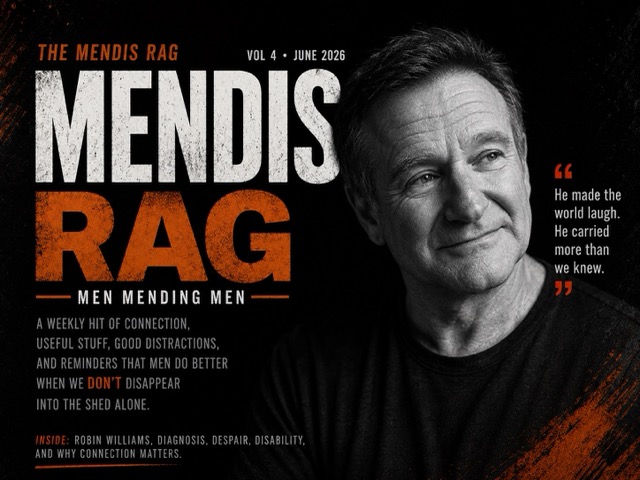
The Mendis Rag · Vol 4 · June 2026
Laughing Loud.
Carrying Quiet.
This issue is about the things men hide behind jokes, the systems that forget humans are attached to spreadsheets, and the strange healing power of a yarn that starts with nonsense and ends with someone feeling less alone.
Feature Article
Robin Williams, Diagnosis, Despair, And The Weight Men Carry Quietly
Robin Williams made the world laugh in a way that felt almost medicinal. Fast, generous, ridiculous, brilliant — like his brain had a trapdoor into a costume cupboard and every character was already warmed up.
He could be a genie, a teacher, a nanny, a doctor, a radio host, a lost boy, a wounded man, and somehow still feel like the same person underneath: mischievous, tender, a bit chaotic, and deeply human.
That is why his death hit so many people in the chest. It was not only the loss of a famous comedian. It was the sickening reminder that a person can look full of life to the world while privately fighting something far heavier than anyone can see.
The cruel part is that, near the end of his life, Robin Williams did not fully know what was happening inside his own body and brain. He had been diagnosed with Parkinson’s disease, but after his death an autopsy revealed Lewy body dementia — a devastating neurodegenerative disease that can affect movement, thinking, mood, sleep, perception and behaviour.
That matters because diagnosis is not just a medical label. Diagnosis shapes what a person thinks their future is. It shapes the treatment they accept. It shapes what their family prepares for. It shapes whether they feel scared, ashamed, hopeful, furious, confused or all of the above before breakfast.
Diagnosis Is Information
It tells a person what might be happening and what help may fit.
Diagnosis Is Identity
It can change how a person sees themselves, their work, their family role and their future.
Diagnosis Is Power
It opens or closes doors to treatment, funding, support, understanding and belief.
Diagnosis Can Be Heavy
When it is wrong, delayed or poorly explained, the damage can be more than paperwork.
It is easy to turn Robin Williams into a sad headline. It is harder, and more useful, to let his story teach us something.
The lesson is not “funny people are secretly sad.” That is too neat. Too lazy. Too fridge-magnet. The better lesson is that men are often trained to perform wellness. We laugh. We deflect. We make a joke before anyone notices the crack in the plaster. We say “all good” with the confidence of a man whose emotional dashboard has every warning light flashing.
Add disability, chronic illness, neurological symptoms, pain, fatigue, income pressure, family stress, identity loss and confusing systems, and suddenly “all good” becomes less of an answer and more of a costume.
The Stats We Cannot Laugh Off
Men. Disability. Suicide. This Is Not A Side Issue.
In Australia, males account for more than three-quarters of suicide deaths. Among people who use disability services, suicide rates are also deeply concerning, with AIHW reporting substantially higher rates for some male disability-service user groups compared with males in the general population.
That does not mean disability causes suicide. It means the load can be dangerous: pain, isolation, poverty, system stress, grief, loss of role, inaccessible services, and the exhausting task of having to prove your needs to people who have never lived your day.
It is not weakness. It is a warning sign. And warnings are meant to make us act.
This is where Mendis comes in. Not as a magic cure. Not as a heroic cape. Definitely not as a group of blokes sitting around saying “have you tried positive thinking?” which, frankly, should be punishable by being forced to assemble flat-pack furniture without the little Allen key.
Mendis exists because men need somewhere to be ordinary and honest at the same time. Somewhere a bloke can talk about NDIS stress, family stuff, pain, brain fog, work loss, medical trauma, loneliness, footy, movies, nonsense, fear, purpose, and whether the barbecue has become a personality.
The jokes matter. Not because they hide the serious stuff, but because they let us approach it without burning our hands. A laugh can be a doorway. A dumb icebreaker can become a real conversation. A throwaway “how are you really going?” can be the sentence that keeps a bloke attached to the world for another week.
So this month, the Mendis challenge is simple: notice the mate who has gone quiet. Notice the man who is always “fine.” Notice the bloke who jokes hardest when life gets heavy. Send the message. Make the call. Share the link. Invite him in.
Because no man should have to perform strength until he breaks. And no man should have to disappear into the shed alone.
Useful source links: Lewy Body Dementia Association on Robin Williams · AIHW disability service users and suicide · ABS suicide deaths data
Article Two
Mendis In Parliament: A Submission From The Cheap Seats Of Real Life
Recently, we made a submission to Parliament about proposed NDIS changes. Not because we enjoy government documents. Nobody enjoys government documents. They are where sentences go to lose the will to live.
We made a submission because the NDIS is too important to be reshaped by panic, slogans and spreadsheet grief. It was created to give disabled Australians choice, control and a fair chance at an ordinary life. Not an extravagant life. Not a gold-plated yacht with an accessible helipad. An ordinary life.
A life where support arrives before crisis. A life where families can stay in work. A life where a person with disability does not need to become a part-time lawyer, accountant and emotional wreck just to get a shower chair, therapy, transport, mentoring, meal support or a human being to help them leave the house.
Plain English Version
What We Were Worried About
- Too much power moving upward — decisions about disabled people being centralised away from the people who live the consequences.
- Too little genuine partnership — consultation that feels rushed, technical and inaccessible to the very people affected.
- Fraud language swallowing everything — as though every support request sits somewhere between “suspicious” and “probably a rort.”
- Appeal rights becoming less meaningful — because a right on paper is not much use if the system can shift the ground underneath you.
- Red tape replacing relationships — more registration, more systems, more audits, but not necessarily better outcomes.
Fraud exists. Exploitation exists. Dodgy providers exist. Criminal behaviour should be found, prosecuted and removed from the scheme. Nobody in Mendis is arguing for a national open bar tab with invoices written in crayon.
But there is a serious difference between stopping fraud and making disabled people feel like the problem. There is a difference between provider integrity and participant suspicion. There is a difference between protecting the scheme and quietly redesigning it so fewer people can use it.
The public conversation has often made the NDIS sound like a giant leaking bucket. But people are not leaks. Support workers are not automatically rorts. Therapy is not a luxury because it happens in a quiet room instead of a hospital ward. Peer support is not fluff because it looks like a conversation.
Some of the most powerful disability supports look boring from far away. A ride to an appointment. A cleaner who prevents a home becoming unsafe. A mentor who keeps a man connected. A group where someone notices if you do not show up. These are not glamorous supports, but they can be the difference between staying well and falling apart.
The Bureaucratic View
“Can this be measured, audited, coded, ruled, restricted and defended?”
The Human View
“Does this help someone live safely, stay connected, build capacity and avoid crisis?”
The Mendis View
“Could we maybe try knowing people before designing systems that accidentally crush them?”
One of our strongest points is simple: if the Government wants to save money, it should stop forcing problems to become expensive before responding to them.
When a person loses support, the cost does not disappear. It moves. It moves to families. It moves to hospitals. It moves to Centrelink. It moves to lost workforce participation. It moves to carer burnout. It moves to mental health crisis. It moves to emergency departments, tribunal lists and legal costs.
The Mendis Alternative
More Humans. Earlier Help. Less Expensive Chaos.
Instead of building a scheme that mainly watches invoices after the fact, imagine local relationship workers who know participants, families and providers. People who can visit, check, explain, guide, resolve and spot trouble before it becomes a scandal.
- Support participants before they reach crisis.
- Help families understand options before they burn out.
- Guide good small providers instead of drowning them in audit theatre.
- Spot dodgy behaviour because someone local actually knows what is happening.
- Reduce needless review fights by fixing confusion early.
That is not soft. That is practical. A good human relationship is not the opposite of integrity. It is often the fastest way to find out what is true.
The NDIS does need reform. But reform should feel like rebuilding a bridge, not pushing people into the river and calling it sustainability.
Useful source links: Parliamentary inquiry page · Government Bill fact sheet · NDIS reform information · ABC on NDIS integrity leakage
Mendis Convo Icebreakers
For When “How Are You?” Gets The Usual Dodgy Answer
Some conversations need a side door. These are small, slightly cheeky, mostly harmless ways to get men talking without making it feel like an emotional tax audit.
What is one thing you are pretending is fine that is absolutely not fine?
Bonus points if it is a household appliance, a body part, or an unread email from someone official.
What would your nervous system be if it was a car?
Reliable Corolla? Overheated Commodore? Mystery warning light since 2019?
What is your most irrationally strong opinion?
Acceptable answers include sauce storage, lawn height, movie sequels and whether socks with holes are “still structurally sound.”
What is one tiny win from this week?
Tiny means tiny. Showered. Replied. Went outside. Did not start a fight with the printer.
Which movie character best represents your current energy?
Rocky training montage? Wall-E low battery? Gandalf blocking one more appointment?
What is one thing a mate could do that would actually help?
Not “fix your life.” More like text, coffee, lift, reminder, laugh, silence, shed time.
Quotes For Blokes Who Pretend They Hate Quotes
Stick These Somewhere Useful
Robin Williams
“Everyone you meet is fighting a battle you know nothing about. Be kind.”
A line often attributed to Robin Williams, and a very Mendis way to move through the world.
Christopher Reeve
“Once you choose hope, anything is possible.”
Not cheesy hope. Working hope. The kind with dirt under its fingernails.
Fred Rogers
“Anything that’s human is mentionable, and anything that is mentionable can be more manageable.”
Basically peer support in a cardigan.
Mendis Translation
“Mate, you do not have to have it all sorted. You just have to not disappear.”
Unofficial. Highly scientific. Probably shed-approved.
Inside Mendis
Tools For Staying Steady When The World Gets Loud
The Mendis idea is simple: connection helps, but practical tools help too. Some weeks need a group chat. Some weeks need a reset. Some weeks need both, plus a snack and a lie down.
Toolbox
The Calm Edge
Practical stress tools for when life, systems or brains get loud.
Audio
Guided Chill Pills
Short guided meditations and nervous system resets for rough weeks.
Calendar
What’s On
Weekly Zooms, footy nights, events, and reasons to reconnect.
Join
Mendis Rookie
Start free. No cape required. Pants preferred for Zoom.
Featured Chill-Pill
Stand Tall
10 minutes · Confidence · Self-Worth · Nervous System
Audio-only version
Stand Tall is a guided reset for self-worth, presence and grounded confidence.
Not hype. Not hollow affirmations. Just posture, breath and quiet authority — reminding your nervous system that you are allowed to take up space.
The Couch Corner
This Month’s Viewing Picks
Movies and shows for when you want something with heart, humour, identity, chaos, or enough emotional damage to count as professional development.
Robin Pick
Dead Poets Society
A reminder that words, courage and a good teacher can rearrange the furniture inside your chest.
Robin Pick
Good Will Hunting
Trauma, defence mechanisms, friendship, and one of the great “it’s not your fault” scenes.
Comfort Chaos
Mrs. Doubtfire
Ridiculous? Yes. Tender? Also yes. Proof that family, grief and fake eyebrows can coexist.
Strange And Human
What Dreams May Come
Visually wild, emotionally heavy, and not one to watch when you are already wobbly.
What’s On
June Reasons To Reconnect
Men’s Health Week
15–21 June. Health is not just check-ups. It is connection, purpose and asking before crisis.
Refugee Week
14–20 June. This year’s theme is A Million Stories. Belonging matters.
Adelaide Disability & WorkAbility Expo
26–27 June at Adelaide Showground. Services, supports, employment pathways and useful conversations.
Mendis What’s On
Wednesday Zooms, Thursday footy, and good humans trying their best.
Mendis Micro-Challenge
The Two-Message Rule
This week, send two messages. One to a mate who makes you laugh. One to a mate who has gone quiet.
The Easy One
Send something stupid, funny or useful. A meme. A song. A footy comment. A photo of a dog looking unemployed.
The Important One
Send something simple: “No need to reply properly, just checking you’re still with us mate.”
No Performance Required
You do not need the perfect words. Perfect words are usually hiding behind not sending anything.
A Serious Note
When The Dark Gets Too Loud
Mendis is peer support. It is connection. It is conversation. It is not crisis care.
If you or someone else is in immediate danger, call emergency services on 000. If you are in Australia and need crisis support, contact Lifeline on 13 11 14 or Suicide Call Back Service on 1300 659 467.
And if you are not at crisis point but you are drifting, isolating, getting darker, using jokes as armour, or quietly thinking everyone would be better off without you — that is enough reason to reach out. You do not have to earn support by falling apart first.
Join. Share. Back. Build.
MEN. MENDING MEN.
If this issue made you think of a mate, send it to him. If it made you think of yourself, join us. Mendis exists because no man should have to perform strength until he breaks.
Wednesdays & Thursdays · 7:30pm SA Time
Join Mendis Join Zoom DonateShare this Rag with one bloke who needs connection, one supporter who needs hope, and one policy person who needs reminding that humans are not line items.
“`