
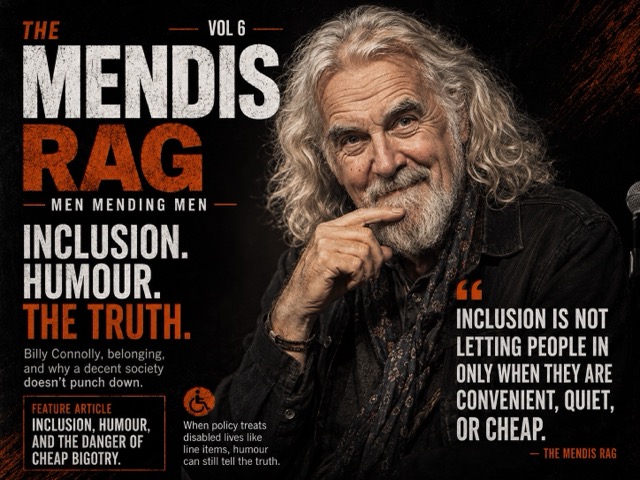
The Mendis Rag · Vol 6 · June 2026
Inclusion.
Humour.
The Truth.
This issue is about the strange power of humour to tell the truth without turning people into targets, the danger of dressing up exclusion as budget discipline, the frontier science giving cautious hope to people with depression, and the mates on bikes pedalling Parkinson’s research forward one stubborn kilometre at a time.
This Week
BYE ROUND
No Mendis session this week. The official advice is: rest like it is a skill, text one bloke who has gone quiet, and do not use the spare hour to accidentally start a massive project in the shed.
Check What’s On Join MendisFeature Article
Inclusion, Humour, And The Danger Of Cheap Bigotry
Billy Connolly built a career out of saying the thing everyone else was too polite, too frightened, or too beige to say.
Proper humour does that. It does not just make a room laugh. It loosens the bolts on false seriousness. It sneaks behind the curtain, points at the machinery, and says, “Hang on, why are we pretending this is normal?” That is why humour matters in disability politics. Not the cheap stuff. Not punching down. Not jokes where disabled people are the prop, the punchline, or the awkward lesson at the end of a school assembly. Real humour punches through. It tells the truth with its eyebrows raised.
Inclusion needs that kind of humour because exclusion has become very good at sounding reasonable. It has learned to wear a suit. It says things like “sustainability,” “integrity,” “tightening access,” and “future generations.” Sometimes those words are legitimate. Fraud should be stopped. Systems should work. Public money matters. But when the solution repeatedly lands on disabled people having less support, less community access, less control, less appeal, and more suspicion, we are allowed to ask whether the spreadsheet has developed a prejudice problem.
That is the dangerous part of the current NDIS conversation. The implied message is not always spoken directly, which makes it harder to pin down. But disabled people hear it clearly enough: you are too expensive, too complicated, too dependent, too often in the community, too much trouble to include unless you can do it quietly and cheaply.
A decent society does not make disabled people audition for belonging. It does not invite people in only when they are convenient, grateful, productive and photogenic. Inclusion is not a special treat handed out when the economy is feeling generous. It is the test of whether our systems understand that human beings are not line items with annoying personalities.
Humour helps because it can expose the absurdity without surrendering to despair. It lets us say, “So the plan is to fight isolation by cutting community access? Brilliant. Should we also improve nutrition by locking the fridge?” It lets people laugh, then think, then maybe feel brave enough to act.
The Mendis version is simple: laugh hard, but never down. Take the piss out of systems, slogans, hypocrisy, cruelty, and the occasional inspirational poster that looks like it was written by a dolphin in HR. But protect the person. Defend the human. Make room.
Article Two
Magic Mushrooms, Depression, And Why Hope Still Needs A Seatbelt
Every few months, a headline appears that makes depression treatment sound like it has finally been solved by a mushroom with a small public relations team.
Psilocybin, the psychedelic compound found in some mushrooms, is genuinely one of the more interesting areas in mental health research. Recent clinical trials have continued to explore whether psilocybin-assisted therapy can reduce symptoms of major depression and treatment-resistant depression. The early story is promising enough to take seriously, but not tidy enough to turn into a fridge magnet.
The key phrase is assisted therapy. This is not “bloke eats mystery fungi behind the shed and meets God, a possum, and three unresolved childhood issues.” In clinical studies, psilocybin is given in controlled settings, with screening, preparation, trained support, monitoring, and integration afterwards. The medicine is not treated like a magic wand. More like a very powerful crowbar that may help open a door — but someone still needs to know what is behind it, and how to walk through safely.
For men with disability, chronic illness, grief, trauma or identity loss, the appeal is obvious. Depression can feel less like sadness and more like being slowly removed from your own life. If new treatments can help people reconnect, that matters. But fringe science becomes dangerous when excitement outruns evidence, access, safety, cost, and proper care.
The Mendis position is cautiously hopeful: cheer the research, protect the humans. Ask better questions. Who benefits? Who can access it? Who is excluded? What supports are wrapped around it? What happens afterwards? And how do we make sure desperate people are not exploited by shiny promises wearing a lab coat?
Depression deserves more tools. But the best tools still need wisdom, supervision, and community. No treatment, however exciting, replaces the ordinary medicine of being believed, connected, supported, and not left alone with the dark.
Useful source links: JAMA Network Open psilocybin trial · JAMA Psychiatry EPISODE trial abstract · ClinicalTrials.gov psilocybin-assisted therapy trial
Article Three
Pedal For Parkinson’s: Craig, The Cogwheelers, And The Beautiful Madness Of Riding For Research
There is something very Mendis about a group of people looking at Parkinson’s and deciding the appropriate response is to get on bikes, punish their legs, raise money, and pretend Lycra is a normal life choice.
Craig Gillespie and Craig’s Cogwheelers have been part of Pedal for Parkinson’s, a cycling fundraiser supporting Shake It Up Australia and Parkinson’s research. Public material from Shake It Up described Craig’s Cogwheelers as a group of more than 30 participants preparing for the Tasmanian challenge, with Craig open about his own Parkinson’s journey, training, family impact and fundraising.
But the best part is not the official wording. It is Craig’s own voice. The post below has exactly the thing disability advocacy often needs more of: lived experience without pity, purpose without polish, and a mate asking people to get behind something that matters.
Straight From Craig
Pedalling Parkinson’s Forward
Craig’s own words say it better than any polished fundraiser paragraph could. This is not abstract awareness. This is a bloke, a bike, a diagnosis, a team, a family, a cause, and the stubborn decision to keep moving forward.
If the Facebook embed does not load, open the post directly through Craig’s Facebook page or visit the Pedal for Parkinson’s fundraiser links.
Mendis Lens
Why This Belongs Here
Because a good fundraiser is not only about dollars. It is about visibility, connection, research, dignity, and giving people a way to fight back that does not require pretending everything is fine.
Parkinson’s can shrink a person’s world by stealing movement, confidence, energy, sleep, work, spontaneity and identity one frustrating little piece at a time. Pedal for Parkinson’s pushes in the opposite direction. It says: we are still here, still moving, still raising money, still making noise, and still allowed to be more than the diagnosis.
And yes, cycling long distances to raise money for a movement disorder is either beautifully poetic or medically suspicious behaviour. Possibly both. Either way, it is exactly the kind of useful madness Mendis can get behind.
If you can donate, donate. If you can share, share. If you can ride, ride. If you cannot do any of that, send encouragement anyway. The cheer squad is not a side issue. Sometimes the person pedalling needs to know there are people on the roadside yelling, “Keep going, mate,” even when the hill is being a smug little bastard.
Useful source links: Shake It Up: Craig’s Cogwheelers · Parkinson’s Australia Craig/Pedal for Parkinson’s reference
The NDIS Bill In Plain Bloke
When “Sustainability” Starts Sounding Like “Stay Home”
The NDIS absolutely needs integrity. Fraud should be found, prosecuted, and launched into the administrative sun. But integrity is not the same thing as suspicion. Reform is not the same thing as removal. And savings are not savings if the cost is simply moved onto families, hospitals, carers and the quiet collapse of people who used to have support.
The Official Phrase
“Sustainability.”
The Lived Question
“Will I still be able to leave the house, stay connected, and avoid crisis?”
The Mendis Translation
“Do not fix the bridge by removing planks and congratulating yourself on lighter infrastructure.”
Useful source links: Parliamentary Library Bill Digest · ABC explainer: contentious parts of the NDIS bill · Government information on the Bill
What To Watch
Comedians, Rebels, Misfits And Truth-Tellers
This month’s watch list is for anyone who likes humour with teeth, humanity with a limp, and stories that understand the best jokes usually have a bruise underneath.
Cover Spirit
Billy Connolly Stand-Up
A reminder that storytelling, mischief and truth can share the same microphone.
The Outsider
There’s Something About Mary
Not exactly a disability masterclass, but a useful reminder that comedy can be kind or cruel depending where the camera points.
Belonging
Forrest Gump
A complicated classic about innocence, difference, history, and the danger of underestimating people.
Truth With Swagger
Pulp Fiction
For no better reason than sometimes men need dialogue, chaos, and a reminder that nobody has their life completely sorted.
What To Listen To
Songs For The Bye Round
No group this week, so here is the unofficial soundtrack for resting, resetting, refusing to disappear, and maybe not starting a fight with the printer.
Ridiculous Joy
Billy Connolly — Wellies
Because silliness is not the opposite of wisdom. Sometimes it is the doorway.
Australian Truth
Paul Kelly — Dumb Things
For anyone who has made an interesting choice and lived to call it character development.
Mendis Mate
Jesse Frick
Local music from inside the reality of disability, creativity and persistence.
Reset
Guided Chill Pills
Short resets for when your nervous system has confused Tuesday with an emergency evacuation.
Mendis Convo Icebreakers
For When The Group Is Having A Bye But The Brain Is Not
No formal Mendis this week, but connection does not need a Zoom link. Use one of these with a mate, family member, or the bloke in your own mirror who keeps pretending he is lower maintenance than he is.
What is one thing you are laughing about because the alternative is screaming into a cushion?
Bonus points if the cushion has already lodged a complaint.
Where do you feel included, and where do you feel tolerated?
There is a difference. One feels like belonging. The other feels like being a complicated chair.
What would you say to the NDIS if it had to sit across from you at the pub?
Keep it legal. Mostly.
What is your tiny bye-round win?
Rested. Walked. Sent a text. Did not start a new hobby involving dangerous tools.
What bit of humour has helped you survive something hard?
A joke, a show, a mate, a meme, or one perfectly timed swear word.
Who needs a check-in from you this week?
Not a wellness seminar. Just a “still here, mate?” message.
Interactive Bit
The Punch-Up / Punch-Down Test
Humour can include people or humiliate them. Before sharing the joke, ask four quick questions.
Who has the power?
If the joke targets the person with less power, it may not be edgy. It may just be lazy.
Who gets to laugh?
Good humour lets people recognise the truth. Cheap humour makes one group the entertainment.
What does it reveal?
A strong joke reveals hypocrisy, absurdity, fear, ego, cruelty or bureaucracy. A weak joke reveals the joker.
Would I say it with them in the room?
If the answer is no, the joke may not be brave. It may just be hiding.
This Month’s Useful Thing
The “No Group This Week” Mate Check
Bye rounds are useful. They are also when some blokes quietly disappear. Here is a copy-and-paste check-in that does not sound like it was written by a committee of scented candles.
Copy / Paste
Low-Pressure Mate Text
“No Mendis this week, mate, but just checking you’re still with us. No need for a proper reply. Send a thumbs up, a swear word, a meme, or proof of life. Also acceptable: a complaint about your body, the government, or the price of chips.”
The trick is to make replying easy. Do not ask for a full emotional annual report. Open the door, leave the light on, and let the bloke walk through without needing to be impressive.
Tiny Wins Board
Bye Round Edition
Not every win looks like an achievement. Some wins look suspiciously like doing less and not feeling guilty about it.
Rested On Purpose
Not collapsed. Not failed. Rested. Like a person doing maintenance before the engine catches fire.
Sent The Text
A simple check-in. A meme. A “you alive?” That counts. Emotional heroism with low admin.
Did Not Doomscroll The Bill
Or only doomscrolled a medium amount, which in current conditions is basically mindfulness.
Laughed Without Apologising
Joy is not disrespectful to struggle. Sometimes it is how struggle gets oxygen.
New Feature
The Mendis Bad Policy Translator
A public service for converting government-adjacent phrases into ordinary human language.
“Sustainability”
Mendis translation: Please check whether this means stopping fraud, or simply making disabled people cheaper.
“Mainstream Services”
Mendis translation: The imaginary place supports go when nobody has funded them properly.
“Choice And Control”
Mendis translation: Beautiful words. Please ensure they survive contact with the actual legislation.
“Consultation”
Mendis translation: Disabled people talking before decisions are made, not after the cake has been baked, iced and defended on breakfast television.
Donate To Mendis
Help Us Keep The Door Open Between Funded Supports
Mendis exists for men with disability who need connection, purpose, humour, tools and somewhere to land when life gets heavy. Some men can use NDIS funding. Many cannot. Some are outside the scheme. Some are waiting. Some are too tired, too proud, too overwhelmed, or too used to being dismissed to ask.
1
Mate Checked In
A small act that can stop a man drifting further out.
1
Session Sponsored
Support helps keep Mendis accessible for men who cannot pay.
1
Door Kept Open
Because isolation does not wait politely for funding approval.
A Serious Note
When The Dark Gets Too Loud
Mendis is peer support. It is connection. It is conversation. It is not crisis care.
If you or someone else is in immediate danger, call emergency services on 000. If you are in Australia and need crisis support, contact Lifeline on 13 11 14 or Suicide Call Back Service on 1300 659 467.
And if you are not at crisis point but you are drifting, isolating, getting darker, using jokes as armour, or quietly thinking everyone would be better off without you — that is enough reason to reach out. You do not have to earn support by falling apart first.
Join. Share. Donate. Return After The Bye.
MEN. MENDING MEN.
If this issue made you think of a mate, send it to him. If it made you think of yourself, join us. If you can help us reach men who cannot pay, donate. Mendis exists because humour, honesty and connection can keep a man attached to the world.
Bye round this week · Back next session · No man disappearing alone
Join Mendis Join Zoom DonateShare this Rag with one bloke who needs a laugh, one family who needs hope, and one policy person who needs reminding that inclusion is not optional architecture.