
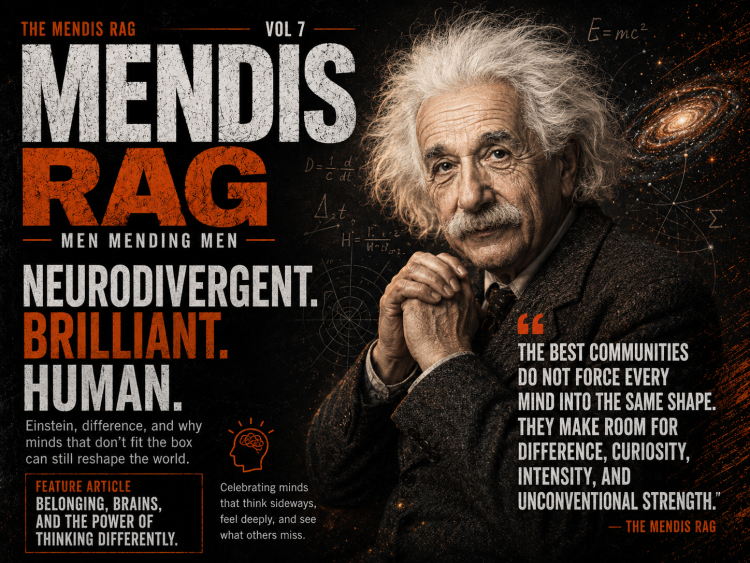
The Mendis Rag · Vol 7 · June 2026
Neurodivergent.
Brilliant.
Human.
This issue is about minds that do not move in straight lines, policies that should make politicians imagine who might inherit their powers, and the quiet brilliance of a phrase the NDIS got right from the start: reasonable and necessary.
Feature Article
Einstein, Difference, And The Physics Of Belonging
Albert Einstein was never officially diagnosed as autistic, ADHD, dyslexic, or anything else we would now place under the broad neurodivergent umbrella. He died before those conversations had the language they have today, and diagnosing dead geniuses is a suspicious little hobby — somewhere between scholarship and historical fan fiction with better footnotes.
But the reason people keep reaching for Einstein in conversations about neurodivergence is not hard to understand. He was intensely focused, famously unconventional, socially unusual, deeply imaginative, and apparently allergic to thinking in the standard-issue straight line. He did not merely answer questions differently. He seemed to ask different questions altogether, which is a useful trick if your plan is to rearrange humanity’s understanding of time, space and gravity before lunch.
The myth version of Einstein is easy: wild hair, big brain, chalkboard, boom, genius. The human version is more interesting. His difference helped him see what others missed, but difference also has a cost. To think sideways in a world built for straight corridors can be lonely. The same intensity that powers insight can make ordinary life awkward. The same imagination that bends light around the sun can fail to bend neatly around school, marriage, work, paperwork, small talk, or whatever fresh hell is happening in a group chat.
That matters for men because many of us are trained to turn difference into armour. The intense bloke becomes “difficult.” The sensitive bloke becomes “too much.” The autistic bloke becomes “rude.” The ADHD bloke becomes “unreliable.” The overwhelmed bloke becomes “lazy.” Eventually, a man can spend more energy translating himself into acceptable shapes than actually living.
Einstein’s science gives us a better metaphor. Relativity taught us that position matters. Movement matters. The observer matters. You cannot understand the universe properly from one fixed viewpoint and then demand reality apologise for being more complex. That is not a bad starting point for community either.
A man’s life looks different depending on where you stand. From outside, he may look successful. From inside, he may be battling noise, shame, fatigue, grief, sensory overload, social confusion, depression, pain, or the lifelong administrative sport of proving he is not making it up. Connection changes the frame of reference. It stops one man’s private struggle from becoming the whole universe.
That is the thread Einstein leaves us — not a diagnosis, but a reminder. The world is made of relationships: between time and space, energy and matter, people and place, men and meaning. Nobody becomes fully human alone. Even the wildest mind needs somewhere to belong.
Useful source links: Retrospective diagnosis debate: Einstein and Asperger’s · Nobel Prize biography: Albert Einstein
Article Two
The Question Mark Butler Should Answer Before He Hands Anyone This Much Power
Here is a thought experiment for Mark Butler. Not a slogan. Not a gotcha. A basic democratic seatbelt.
Imagine Pauline Hanson is Prime Minister. Imagine One Nation is riding high in the polls, the major parties are rattled, and a future government introduces an NDIS bill that proposes to slash community access, reduce support categories by sweeping percentages, and give a minister power to cut almost anything they choose by regulation.
Would Labor vote for that?
Not this Labor. Not this minister. Not this reassuring press conference. A future government. A different minister. A hostile cabinet. A political environment where disabled people are already being framed as too expensive, too dependent, too visible, too often in public, and not quite grateful enough for the privilege of basic participation.
Governments hate this premise because it ruins the mood. They want disabled people to trust the current intention. But democracy is not built on trusting today’s minister. It is built on limiting tomorrow’s minister. That is why appeal rights matter. Why definitions matter. Why delegated powers matter. Why “don’t worry, we would never use it like that” is not a safeguard. It is a vibe wearing a lanyard.
The real question is not whether Mark Butler believes he is acting in good faith. He probably does. The question is whether he is comfortable creating a machine that someone else could drive through disabled people’s lives with far less restraint.
If the power could be used to cut supports that let people leave the house, build skills, stay connected, or avoid crisis, then it is not a technical detail. It is the architecture of belonging. And if that power feels frightening in Pauline Hanson’s hands, it should be narrowed in everyone’s hands.
Disabled people are not being paranoid when they ask politicians to imagine the worst possible user of a power before creating it. That is not cynicism. That is civics with a memory.
Useful source links: Parliament Bill page · UNSW analysis of proposed NDIS changes · Roy Morgan polling: One Nation primary support
Article Three
Reasonable And Necessary: The Budget Test Government Forgot To Apply To Itself
The phrase “reasonable and necessary” is one of the best things the NDIS ever gave Australia.
It is simple without being stupid. It does not promise luxury. It does not say every want becomes an invoice. It asks whether a support is connected to disability, whether it helps a person live, participate, build capacity, reduce harm, or avoid bigger costs later. It is not perfect, because no phrase survives contact with bureaucracy without needing a lie down. But as a moral and practical test, it is excellent.
The odd thing is that disabled people are forced through the reasonable-and-necessary keyhole while the rest of government spending often strolls through the front door wearing sunglasses.
Apply The Same Test Everywhere
Reasonable And Necessary?
- Up to $7 billion for counter-drone defence, plus broader drone capability spending, while Australia has no obvious short-range drone army gathering at the Murray Bridge bakery — reasonable and necessary? 🤔
- Natural resources leaving the country with comparatively low public return, while Australians are told disability support must be squeezed for sustainability — reasonable and necessary? 🤔
- Diesel fuel tax credits costing the budget tens of billions over coming years, including benefits to industries already profiting from public resources — reasonable and necessary? 🤔
- Hundreds of billions for submarines that may arrive around the same time my knees are old enough to lodge their own NDIS access request — reasonable and necessary? 🤔
- Consultant contracts, stadium upgrades, fossil-fuel concessions, marginal-seat monuments, and hard-hat announcements with more photographers than evidence — reasonable and necessary? 🤔
The point is not that defence, infrastructure or industry support are automatically wrong. The point is that disabled people are asked to justify a support worker, therapy session, transport trip or communication aid with forensic precision, while much larger spending decisions often glide past under the protective fog of “national interest,” “economic growth,” or “strategic necessity.”
If reasonable and necessary is good enough for a disabled person trying to leave the house, it is good enough for a government trying to spend billions.
Suddenly the NDIS starts looking less like the rorty portfolio and more like the portfolio where human need is actually interrogated. A support worker taking someone into the community must be justified. Therapy must be justified. Transport must be justified. A communication device must be justified. But elsewhere, billions can move under headings so large they become fog.
NDIS growth should not automatically be called a blowout. Sometimes growth means the country finally counted people it had ignored. Sometimes it means family carers are exhausted. Sometimes it means children survived earlier, adults lived longer, diagnoses improved, schools referred properly, and people who had been hidden at home finally became visible enough to need support.
That is not failure. That is truth arriving with invoices.
Fraud should be pursued. Waste should be removed. But the core idea should be defended, not mocked. Reasonable and necessary is not soft. It is disciplined human dignity. If applied across the whole budget, it might be the most radical fiscal reform in the country.
The Mendis Lens
Difference Is Not A Defect
Neurodivergence is not a decorative word for genius. It is a broad, messy, human reality. It can come with creativity, pattern recognition, intense focus, humour, honesty, sensory brilliance and unusual insight. It can also come with burnout, anxiety, shame, executive dysfunction, social cost, rejection and the daily effort of translating yourself for people who think their operating system is the only one installed.
The Lazy View
“Why can’t he just be normal?”
The Better Question
“What conditions help this man participate, contribute and stay well?”
The Mendis Translation
“Stop demanding one shape of manhood and acting surprised when men disappear.”
What To Watch
Different Minds, Big Questions, Human Mess
This month’s watch list is for anyone interested in intelligence, difference, connection, obsession, social awkwardness, and the fine line between “brilliant” and “please answer the text like a normal person.”
Thinking Differently
A Beautiful Mind
A powerful story about brilliance, love, perception, illness, identity and being more than the label.
Code & Isolation
The Imitation Game
A reminder that a society can use a mind and still fail the person carrying it.
Relativity Vibes
Interstellar
Time, gravity, love, sacrifice, and the emotional damage of space doing weird things to clocks.
Memory & Meaning
Eternal Sunshine Of The Spotless Mind
Brains, love, loss, identity, and proof that forgetting is not the same as healing.
What To Listen To
Songs For Sideways Minds
A small soundtrack for intensity, restlessness, belonging, and thinking too much at 11:47pm like the brain has opened a conference.
Difference
David Bowie — Changes
For everyone who has had to keep becoming themselves in public.
Odd Energy
Talking Heads — Once In A Lifetime
A song for waking up inside your own life and wondering who approved the floor plan.
Mendis Mate
Jesse Frick
Local music from inside the reality of disability, creativity and persistence.
Reset
Guided Chill Pills
Short resets for when your nervous system is doing interpretive dance in a hardware store.
Mendis Convo Icebreakers
For When Your Brain Has Formed A Subcommittee
Use one of these with a mate, in the forums, or with yourself if you are currently overthinking a text message from 2017.
What is one thing your brain does that is annoying but occasionally brilliant?
Examples may include pattern spotting, overthinking, remembering useless facts, or detecting hypocrisy at 300 metres.
Where do you feel like you have to translate yourself?
Work, family, appointments, school meetings, Centrelink forms, or anywhere fluorescent lighting is involved.
What is your current theory of relativity?
As in: what feels different depending on who you are around?
What condition helps you be your best self?
Quiet, structure, movement, humour, coffee, written instructions, fewer humans, better humans.
What is one strength you have been taught to treat like a problem?
Intensity. Sensitivity. Honesty. Persistence. Curiosity. The inability to tolerate nonsense.
Who is one person who gets you without needing subtitles?
Text them. They may also be hiding in a shed pretending they are fine.
Interactive Bit
The Frame Of Reference Check
Einstein gave physics relativity. Mendis gives blokes a much less Nobel-worthy version for checking how life feels from different positions.
How do I look from the outside?
Capable, funny, working, parenting, quiet, successful, calm, or suspiciously composed for a man held together by caffeine and resentment.
What is happening inside?
Noise, pain, shame, fatigue, overload, grief, fear, racing thoughts, shutdown, or the emotional equivalent of dial-up internet.
Who sees the real load?
Name one person. If the answer is nobody, that is not proof you are strong. It may be proof you are isolated.
What would connection change?
Not everything. But maybe enough. A message, a group, a walk, a forum post, a practical ask, one honest sentence.
This Month’s Useful Thing
The “How My Brain Works” Card
Neurodivergent men often spend years explaining themselves badly while exhausted. This is a simple note you can keep in your phone for appointments, work, family conversations, or any situation where your brain refuses to perform customer service.
Copy / Paste
How My Brain Works Best
- I do best when: information is clear, written down, and not rushed.
- I struggle when: there is too much noise, pressure, ambiguity, interruption or emotional heat.
- People may misread me as: rude, distracted, intense, withdrawn, argumentative, lazy or difficult.
- What is usually happening: I am processing, overloaded, trying to be precise, or using energy you cannot see.
- What helps: time, directness, humour, practical steps, belief, and not making me prove the same thing repeatedly.
This is not an excuse card. It is a translation card. There is a difference.
Tiny Wins Board
Sideways Mind Edition
Small wins count, especially when your brain treats ordinary life like an escape room designed by a committee.
Asked For Clarity
Instead of pretending you understood and then panic-interpreting the instructions later in the car.
Left Before Overload
Not rude. Not weak. Strategic withdrawal before your nervous system starts throwing furniture internally.
Told The Truth Earlier
“I’m not coping with this” is better before the collapse than after the emotional building inspection.
Used The Weird Strength
Pattern spotted. Problem solved. Hypocrisy detected. Random fact useful for the first time since 1998.
New Feature
The Mendis Reasonable & Necessary Budget Translator
A public service for testing whether government spending could survive the same questions disabled people face every day.
Is it connected to actual need?
If the answer is “strategic optics,” “legacy project,” or “because a marginal seat enjoys concrete,” please resubmit with evidence.
Does it build capacity?
Does it help people live, work, learn, participate, stay safe, or avoid crisis? Or does it just photograph well in a hard hat?
Is there a cheaper option that still works?
Disabled people are asked this constantly. It seems only polite to ask the submarines, consultants and stadiums as well.
Who carries the cost if we say no?
When support is cut, cost does not vanish. It moves to families, hospitals, carers, poverty, crisis and human wreckage.
Donate To Mendis
Help Us Make Room For Men Who Think, Feel And Struggle Differently
Mendis exists for men with disability who need connection, purpose, humour, tools and somewhere to land when life gets heavy. Some men can use NDIS funding. Many cannot. Some are outside the scheme. Some are waiting. Some are too tired, too proud, too overwhelmed, or too used to being dismissed to ask.
1
Bloke Included
A place to belong before isolation becomes crisis.
1
Family Supported
When men are less isolated, partners, kids, carers and communities feel the difference too.
1
Door Kept Open
Because support should not depend entirely on whether a funding portal says yes.
A Serious Note
When The Dark Gets Too Loud
Mendis is peer support. It is connection. It is conversation. It is not crisis care.
If you or someone else is in immediate danger, call emergency services on 000. If you are in Australia and need crisis support, contact Lifeline on 13 11 14 or Suicide Call Back Service on 1300 659 467.
And if you are not at crisis point but you are drifting, isolating, getting darker, using jokes as armour, or quietly thinking everyone would be better off without you — that is enough reason to reach out. You do not have to earn support by falling apart first.
Join. Share. Donate. Think Sideways.
MEN. MENDING MEN.
If this issue made you think of a mate, send it to him. If it made you think of yourself, join us. If you can help us reach men who cannot pay, donate. Mendis exists because men do better when difference has somewhere to belong.
Weekly connection · Useful tools · Good distractions · No man disappearing alone
Join Mendis Join Zoom DonateShare this Rag with one bloke whose brain never shuts up, one family who needs hope, and one policy person who needs a proper frame of reference.