
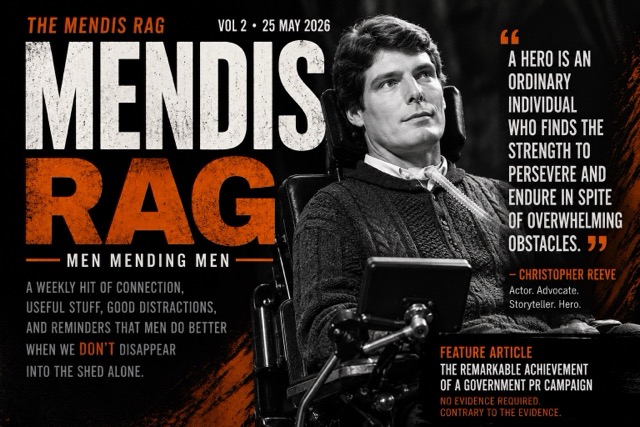
The Mendis Rag · Vol 2 · May 2026
The Evidence Gap
Inside the NDIS Debate
Fraud exists. Dodgy providers exist. But good policy needs evidence, not scary fog machines, budget panic, and a national mood where disabled people feel like suspects for needing support.
Feature Article
Australians Were Told The NDIS Had A Massive Fraud Problem.
So Where Is The Evidence?
Over the past two years, Australians have heard a very clear message: the NDIS is being rorted, billions are leaking out, organised crime is circling, and the system needs a serious crackdown.
Some of that concern is fair. Fraud should be found. Criminals should be prosecuted. Providers who exploit disabled people should be shown the door, preferably with a brisk shove.
But here is the bit that matters: fraud, leakage, billing errors, provider non-compliance, participant disputes and tribunal appeals are not the same thing.
Fraud
Deliberate theft, fake invoices, organised crime, and intentional deception.
Leakage
A broad bucket that can include fraud, mistakes, overcharging, poor paperwork and non-compliance.
Disputes
Participants challenging decisions about eligibility, budgets, supports or plan changes.
Suspicious Claims
Claims paused, reviewed or questioned. Suspicious does not automatically mean fraudulent.
That distinction has been badly blurred. Public debate has often jumped from “there may be billions in integrity leakage” to the public hearing “billions are being stolen.” Those are very different claims.
The Maths Test
What Would 10% Fraud Actually Look Like?
Take a simple working example:
- 700,000 participants
- 100 claimable transactions per participant per year
- 10% fraudulent transactions
That would mean about 14 million fraudulent receipts over two years.
That is not “a few dodgy invoices.” That is a mountain range of evidence.
But the hard public evidence has not looked like that. We have seen investigations, prosecutions, warrants and provider actions. We have not seen anything close to an evidence trail matching the loudest public mood.
Freedom of Information material and Senate Estimates questioning have pointed to a much more complicated picture. One reported figure discussed around 171 actionable matters emerging from a far larger pool of flagged activity.
That does not prove there are only 171 problems. But it does make one thing clear: big scary numbers need big clear evidence.
Then there is the review system.
Governments can proudly say they have stopped thousands of suspicious claims. But if many NDIS decisions are later overturned, withdrawn, changed or settled before tribunal, then stopping the claim may not always be “protecting the taxpayer.” Sometimes it may simply be delaying support until a participant has suffered enough to prove the obvious.
The power imbalance is enormous. The NDIA has lawyers, experts, internal staff and taxpayer-funded machinery. Participants are often exhausted families, carers, disabled people, or advocates trying to explain real life to a system that already said no.
And when those matters settle or shift in the participant’s favour, taxpayers effectively pay twice: once for the original decision-making process, and again for the legal and review process needed to fix it.
Fraud prevention matters. Accountability matters. But evidence matters too. A mature disability system should be able to hunt criminals without making ordinary disabled Australians feel like they need a defence lawyer for living their lives.
Christopher Reeve once said a hero is an ordinary person who finds strength to persevere despite overwhelming obstacles. Most NDIS participants are not villains in a broken system. They are ordinary Australians already carrying overwhelming obstacles, still trying to keep going.
Useful source links: NDIS fraud and non-compliance · ABC reporting on integrity leakage · Administrative Review Tribunal NDIS reviews
Mendis Solutions
What If The “Expensive” Human Solution Is Actually Cheaper?
The current answer seems to be more systems, more registration, more auditing, more taskforces, more payment controls and more legal fights.
That might sound tough. It also sounds expensive. And weirdly familiar. We have tried building big systems to manage people from a distance. The distance is often where the trouble starts.
The Announced Spend
The Current Reform Path Is Not Cheap
- $358.5 million for a new digital payment and provider enrolment system.
- $280.1 million over five years for the Fraud Fusion Taskforce, then about $53 million per year ongoing.
- $182.6 million over four years for expanded mandatory registration of high-risk providers.
- $21.7 million additional funding for the NDIS Quality and Safeguards Commission.
That is about $842.9 million in listed measures before tribunal fights, legal costs, auditing burden, rework and human fallout are fully counted.
And that is the important bit. The public sees “crackdown.” The spreadsheet sees something else:
Legal Costs
Every unnecessary review means lawyers, experts, administration and delay.
Audit Costs
Registration can push money toward auditors instead of supports, especially if outcome evidence is weak.
Provider Burden
Good small providers may leave if compliance becomes bigger than care.
Human Cost
Delayed support can become crisis, carer burnout, hospital visits and worse outcomes.
The Mendis Alternative
Put Real Humans Back In The System
Imagine 1,500 community-based NDIS relationship workers based through LAC-style local offices. Their job is not to sit in Canberra inventing forms. Their job is to know people.
- Know the participants.
- Know the providers.
- Visit in person.
- Fix confusion early.
- Spot dodgy patterns before they become national scandals.
- Stop needless disputes before they become tribunal fights.
The Rough Cost
- 1,500 frontline workers at $100,000: $150 million per year.
- 1,500 admin/support staff at $75,000: $112.5 million per year.
Base workforce cost: $262.5 million per year.
Even with substantial overheads, training, travel and office costs, this model could plausibly sit below the real cost of a compliance-heavy system once legal reviews, auditing, duplicated decisions and crisis costs are included.
In plain English: spend more money on people who prevent mess, and less money cleaning up mess with lawyers, auditors and national panic buttons.
Fewer Tribunals
Because issues are fixed before everyone has aged six months and developed a twitch.
Less Fraud
Dodgy behaviour is harder when someone local actually knows what is happening.
Less Red Tape
Good providers get guidance, not endless audit theatre.
More Trust
Participants stop feeling hunted and start feeling understood.
There is also a serious evidence problem with assuming registration automatically means better outcomes. Registration may make sense for high-risk supports. But there is limited public evidence showing registered providers consistently produce better participant outcomes than unregistered providers across the whole scheme.
If the evidence is not there, then mandatory registration risks becoming an expensive paperwork machine — great for auditors, rough for good small providers, and not necessarily better for participants.
Budget source links: Team DSC budget breakdown · QDN budget update · Federal Budget care and opportunity chapter
Inside Mendis
Tools For Staying Steady
When the news, the system, or your own nervous system gets loud, Mendis has practical tools to help you reset without pretending everything is fine.
The Calm Edge
Practical stress tools for when life, systems or brains get loud.
Guided Chill Pills
Short guided meditations and nervous system resets for rough weeks.
Full Chill-Pill Library
Browse confidence tools, calm-down sessions and guided resets.
Featured Chill-Pill
Stand Tall
10 minutes · Confidence · Self-Worth · Nervous System
Audio-only version
Stand Tall is a guided reset for self-worth, presence and grounded confidence.
Not hype. Not hollow affirmations. Just posture, breath and quiet authority — reminding your nervous system that you are allowed to take up space.
The Couch Corner
This Week’s Viewing Picks
TV Series
Breaking Bad
Systems, pressure, pride and what happens when nobody taps the brakes.
TV Series
Westworld
Identity, control, memory and robots having a workplace dispute with humanity.
Film
Blade Runner
Still the coolest existential crisis ever filmed.
Film
Pulp Fiction
Not therapy. Definitely conversation fuel.
What’s On
Good Reasons To Reconnect
Reconciliation Week
27 May – 3 June. Connection is built through action, not slogans.
SA History Festival
Stories, connection and proof that humans have survived messy times before.
Adelaide Cabaret Festival
Music, comedy, theatre and glorious weirdness.
Mendis What’s On
Weekly Zooms, peer chats and good humans trying their best.
The Mendis Challenge
Do Not Disappear
This week, do one thing that keeps you connected.
- Send one message.
- Check on one mate.
- Join one Zoom.
- Try one Guided Chill-Pill.
- Ask for help before the wheels fall off.
Join. Back. Donate. Share.
MEN. MENDING MEN.
If this climate is making life harder for disabled men, Mendis has to become easier to find, easier to join and easier to sustain.
Wednesdays & Thursdays · 7:30pm SA Time
Join Mendis Join Zoom Donate